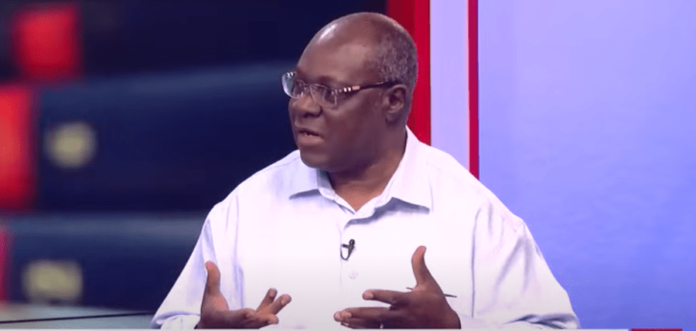
A leading member of the New Patriotic Party (NPP), Dr Arthur Kobina Kennedy, has raised concerns over what he describes as the growing monetisation of internal party politics, warning that the trend is eroding inclusivity, weakening meritocracy, and deepening divisions within political parties in Ghana.
Speaking in a recent discussion, Dr Kennedy argued that although money has always played a role in party politics, its influence has intensified in recent years, with damaging consequences for democratic participation.
“Monetisation has gotten worse,” he stated, adding that political parties themselves bear responsibility for allowing the practice to grow unchecked.
According to him, the expansion of the delegate system — which was intended to broaden participation — has paradoxically narrowed inclusivity within parties.
“Inclusivity has gotten worse. It’s now almost a case of ‘if you are not with me, you are against me,’” Dr Kennedy said, noting that the political space no longer accommodates neutrality or internal dissent.
He recalled that in earlier years, party leaders openly acknowledged the existence of factions and made deliberate efforts to manage and reconcile them in the interest of unity.
“The duty of leadership was to unite and pacify factions. That understanding is gone,” he lamented.
Dr Kennedy also criticised what he described as the collapse of informal meritocratic systems within party structures, arguing that competence and experience once played a quiet but decisive role in leadership selection.
“There used to be an understood sense that certain people were unqualified to do certain things. All that has broken down,” he said.
He added that the presence of some current national executives has negatively affected the party’s public image, describing certain appointments as damaging to the party’s credibility.
Reflecting on the party’s early organisational years, Dr Kennedy highlighted a culture of sacrifice, collegiality, and transparent fundraising, where activities were sustained through modest but honest contributions.
“There was not much dark money. It was sacrificial, honest money keeping the party running,” he recalled.
In contrast, he said modern party financing is increasingly driven by wealthy political financiers who treat elections as investments, expecting contracts and favours in return when the party gains power.
“People now finance campaigns with the expectation that when we come to power, they will be rewarded. That has made our politics darker and less ideal,” he warned.
Dr Kennedy further questioned recent internal party reforms, particularly those concerning leadership structures, arguing that real power within political parties is inseparable from access to state resources.
“A president controls more resources, so for all practical purposes, he becomes the de facto leader of the party, regardless of what the constitution says,” he explained.
He also observed that party officials who take up government appointments often lose their independence, becoming overly compliant due to the president’s control over thousands of appointments.
“Many have become so sycophantic that nobody hears of them,” he said.