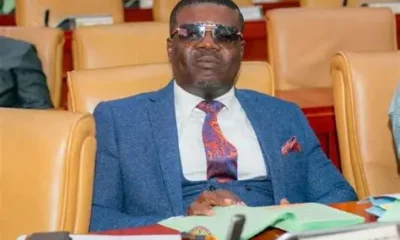
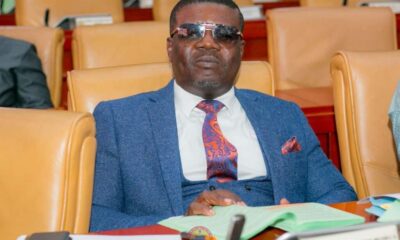
Concerns over the cost-effectiveness of the Office of the Special Prosecutor (OSP) have resurfaced in Parliament, with Majority Chief Whip and South Dayi MP Rockson-Nelson Dafeamekpor accusing the institution of draining public funds without delivering tangible prosecutorial outcomes.
Speaking on Joy FM’s Super Morning Show on Monday, December 22, Mr Dafeamekpor described the OSP as an office that has failed to justify the scale of resources committed to it, bluntly characterising the institution as one that is “just guzzling money.”
His remarks come in the wake of a private member’s bill he co-authored with Majority Leader Mahama Ayariga, which seeks to repeal the Office of the Special Prosecutor Act and abolish the OSP. Although the draft bill has yet to be formally laid before Parliament, it has already reignited debate over the future of Ghana’s anti-corruption architecture.
Mr Dafeamekpor disclosed that Parliament approved a GH¢250 million budget for the OSP for the 2026 financial year, an allocation he said mirrors what the office received in 2025. He questioned whether the returns on such an investment justify continued funding at that level.
According to him, the OSP’s budget is comparable to that of the Attorney-General’s Department, an institution he argued delivers significantly greater value through prosecutions conducted nationwide. “The entity was just guzzling money,” he said.
He contrasted the OSP’s operations with those of the Attorney-General’s Department, which maintains regional offices across the country and supervises prosecutions carried out at the district level by police prosecutors. Mr Dafeamekpor explained that cases handled by police prosecutors are legally prosecuted in the name of the Attorney-General and therefore form part of the department’s overall output.
In his view, this highlights a sharp disparity between the two institutions. “If you compare the utility value the Attorney-General is giving us, it is clear,” he stated.
Mr Dafeamekpor clarified that his criticism was not a call for convictions at all costs but rather for decisive prosecutorial action once investigations are completed.
“Nobody is saying imprison people. What we are saying is that once cases are prosecutable, prosecute them and let the accused persons have their day in court so the cases can be disposed of.”
He further accused the OSP of pursuing lengthy investigations without conclusion, opting instead to issue repeated public reports rather than filing cases before the courts—an approach he said delays justice and erodes public confidence.
Beyond performance concerns, the Majority Chief Whip also raised allegations of intimidation involving lawyers who engage with the OSP. He cited incidents involving legal practitioners Israel Ackah and Martin Kpebu, alleging that Mr Ackah was arrested after accompanying a client to the OSP following a disagreement with officials.
“Israel took a client to the OSP and for some disagreement, he was restrained and placed under arrest. It took some effort to bring him out,” he said, describing the incident as troubling and inconsistent with due process.
Mr Dafeamekpor maintained that the Majority’s position is that funds currently allocated to the OSP would be better deployed through the Attorney-General’s Department. He argued that with enhanced resources, the department could recruit additional lawyers, strengthen prosecutorial capacity, and more effectively handle corruption-related cases nationwide.
His comments come against the backdrop of President John Mahama’s caution against scrapping the OSP, with the President insisting that it is too early to dismantle the institution and that it still plays an important role in Ghana’s anti-corruption framework.