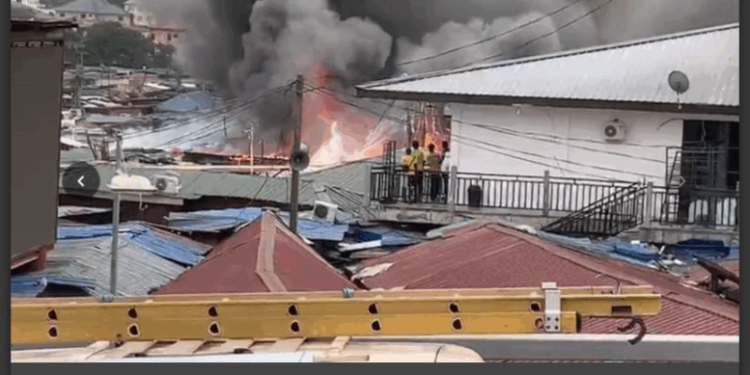
Fresh details have emerged explaining why the fire outbreak behind the VVIP Station at Kwame Nkrumah Circle proved difficult to contain, despite the swift response of firefighters.
According to the Ghana National Fire Service (GNFS), a combination of delayed emergency reporting, restricted access, gas explosions and unsafe electrical connections significantly complicated efforts to bring the blaze under control.
The fire, which erupted around 10:00 a.m. on Tuesday, January 20, 2026, razed over 50 mobile phone shops, eyewitnesses and officials confirmed.
Speaking on Breakfast Daily on Channel One TV on Friday, January 23, the Head of Public Affairs of the GNFS, DOII Desmond Ackah, said the most critical setback occurred even before firefighters arrived at the scene.
He explained that the late call-up allowed the fire to intensify beyond manageable levels.
“Anytime we receive late calls to emergencies, by the time we get there, things would have degenerated into what we don’t want to witness,” he said.
Once firefighters arrived, they encountered severe access challenges, which slowed down direct firefighting operations. DOII Ackah revealed that the narrow and congested layout of the area forced crews to lay extended hose lines before reaching the core of the fire.
This, he noted, required higher water pressure, caused excessive water loss and delayed effective suppression of the flames.
“We had a difficult time even gaining access to where the fire was actually raging. When you don’t have direct access, you have to lay more hoses to reach the source,” he explained.
The situation was further aggravated by the presence of gas cylinders and stoves inside many of the shops. As the fire spread, intermittent explosions repeatedly reignited surrounding combustible materials.
“When there is an explosion, the combustible gases are thrown far, and the unburnt gases are also ignited, spreading the fire,” DOII Ackah noted, adding that such conditions make containment within confined spaces extremely difficult.
Firefighters also faced serious safety risks due to illegal and poorly connected electrical wiring. According to the GNFS, multiple shops were linked to single meters using substandard cables, creating live electrical hazards at the scene.
“It became apparent that about 10 shops could be connected to just one meter. The wires were connected anyhow,” he said.
The erratic wiring initially exposed firefighters to electrocution risks, forcing the team to pause operations to isolate power sources. However, the problem was compounded by the fact that electricity had been tapped from multiple transformers, making complete isolation uncertain.
“Even when you isolate power from one source, you may not be certain because electricity could still be flowing from another source. It was dicey,” he added.
Despite these challenges, the GNFS eventually brought the fire under control, preventing it from spreading further into surrounding commercial areas.